
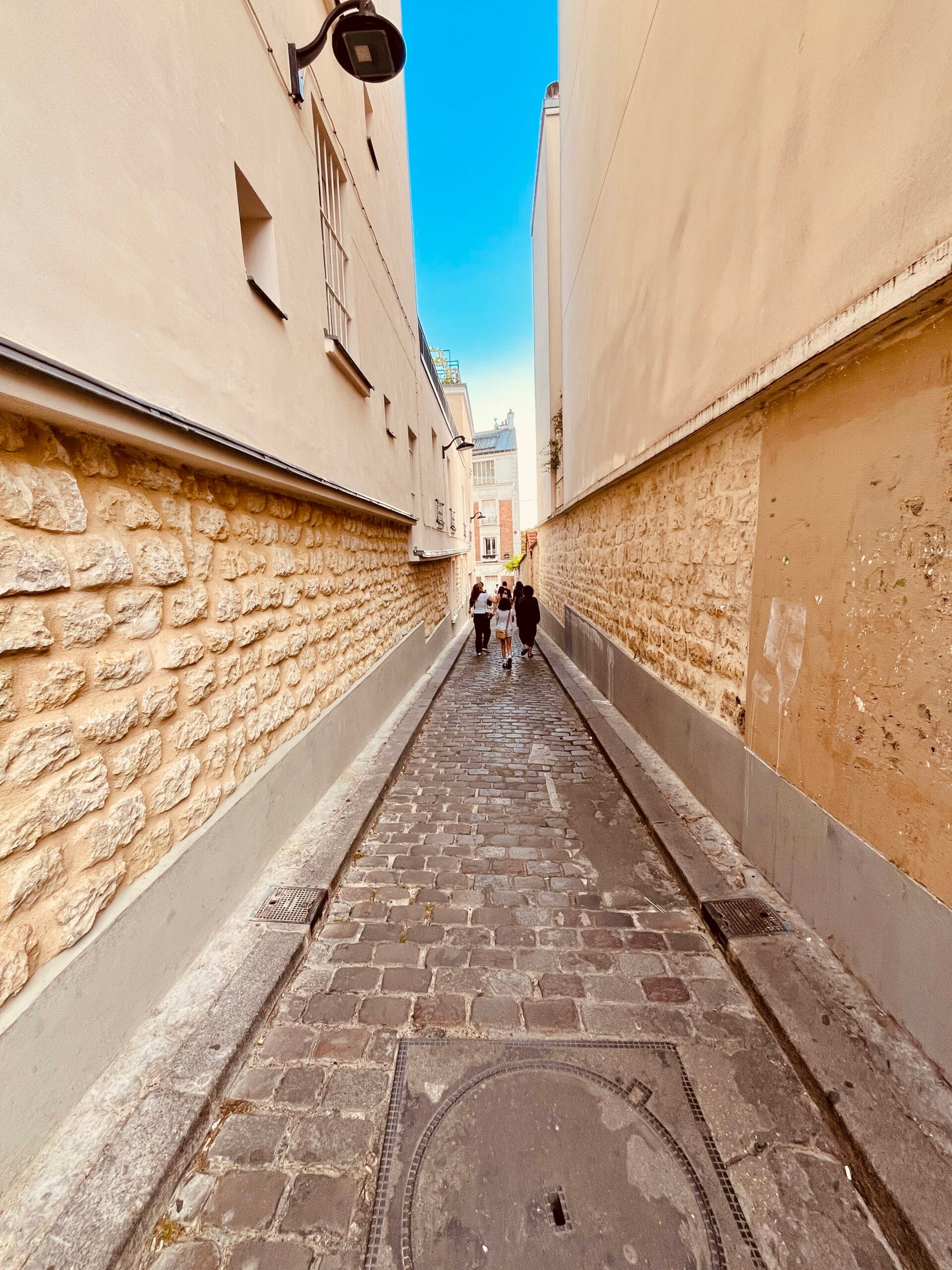


Most Montmartre itineraries cover the same circuit: Sacre-Coeur steps, Place du Tertre, Rue Lepic, Moulin Rouge. All worth seeing. But the neighbourhood has a second layer — quieter, less photographed, and in some ways more interesting — that sits just a few minutes off those main paths. These are the spots locals know and most visitors miss entirely. The main circuit is covered in our complete Montmartre guide.
1. Place Dalida — The Best Sacre-Coeur View Nobody Talks About
Named for Dalida — the Egyptian-Italian singer who became one of France’s most beloved performers and lived in Montmartre until her death in 1987 — this small square sits on the northern slope of the Butte, a two-minute walk from Rue de l’Abreuvoir. At its centre stands a bronze bust of Dalida by the sculptor Alain Aslan. Local legend holds that touching the bust brings good luck, which explains why the metal is worn smooth in certain places.
The real reason to come here is the view. Place Dalida offers one of the most open, unobstructed sightlines to Sacre-Coeur on the entire Butte — no scaffolding, no tour groups, no souvenir stalls. The basilica appears framed by the rooflines of the surrounding houses. In the morning, it catches the first light. This is the composition most photographers are looking for and not finding at the main viewpoints.
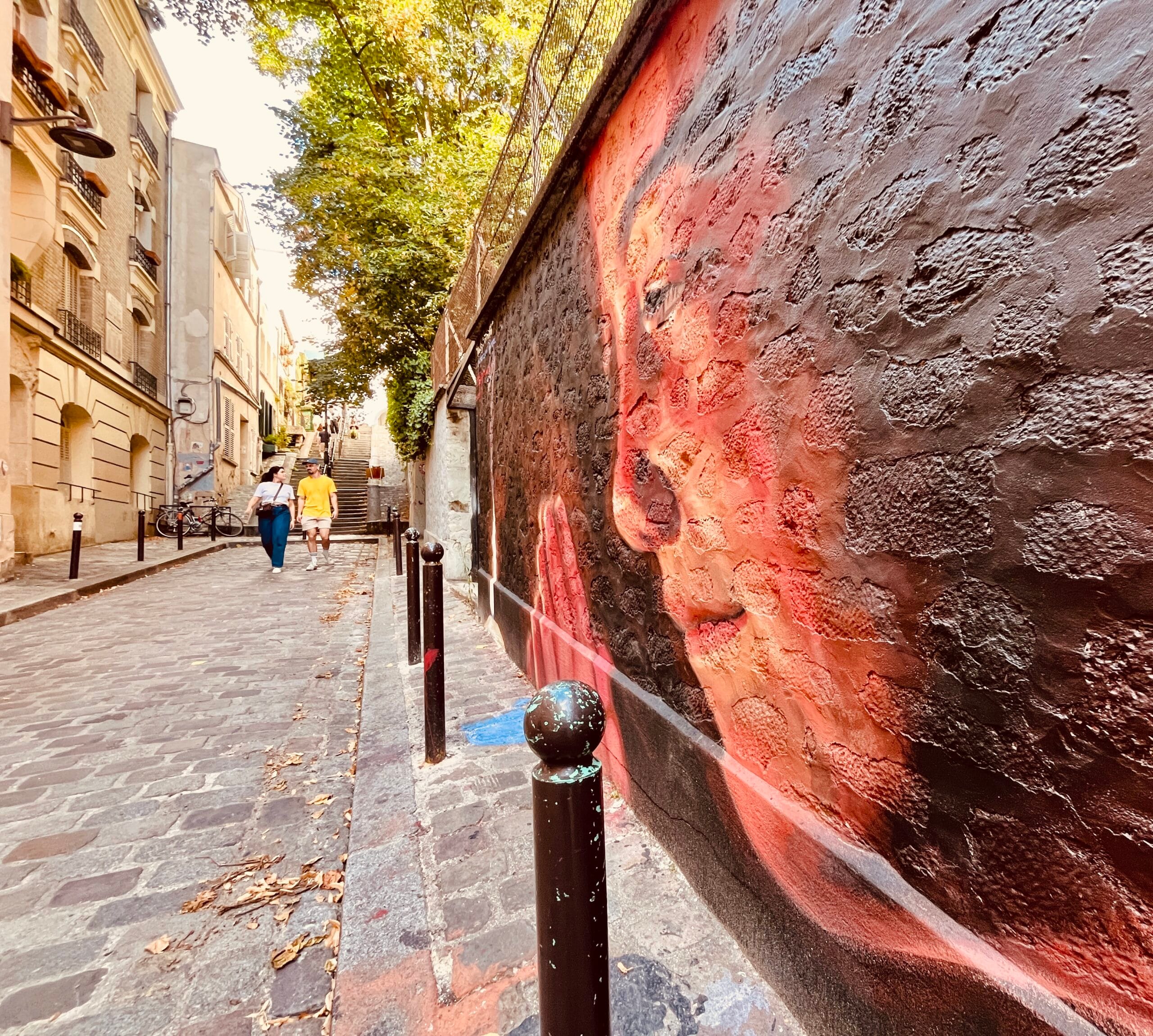
Place Dalida — the Sacre-Coeur view most visitors never find © montmartre-in-paris.com
2. Le Passe-Muraille — The Man Who Walked Through Walls
On a quiet square off Rue Norwins stands one of the most charming sculptures in Paris — and one that most visitors to Montmartre never see. Le Passe-Muraille (The Man Who Walked Through Walls) depicts a figure half-emerged from a stone wall, as if caught mid-passage. The bronze was created by Jean Marais in 1989 as a tribute to the writer Marcel Ayme, who lived on this square and wrote the short story of the same name about a man with the supernatural ability to pass through solid walls.
The square itself is one of the prettiest in Montmartre — small, tree-lined, residential. It sits between Place du Tertre and the vineyard, which means it is surrounded by tourist circuits on all sides while somehow remaining almost entirely unknown to them. Come here and you will almost certainly have it to yourself.
3. The Wall of Love — 312 Languages, One Small Garden
On the north side of Place des Abbesses, tucked into a small garden, is Le Mur des Je t’aime — a blue ceramic tile installation covering 40 square metres, on which the phrase ‘I love you’ is written 612 times in 250 different scripts and 312 languages. It was created in 2000 by artist Frederic Baron and calligrapher Claire Kito, who spent years collecting the phrase from native speakers around the world. Note (summer 2026): the wall is currently undergoing restoration and is partially obscured by scaffolding. The garden square remains accessible and the tiles are still visible — but hold off on making it your hero shot until work is complete.
The red fragments scattered across the tiles represent the pieces of a broken heart. The whole thing is free, takes three minutes to see, and is far more affecting in person than photographs suggest. It is also one of the most popular proposal spots in Paris, which means the garden has a particular energy in the late afternoon and evenings. For more places that cost nothing, see our guide to free and cheap things to do in Montmartre.
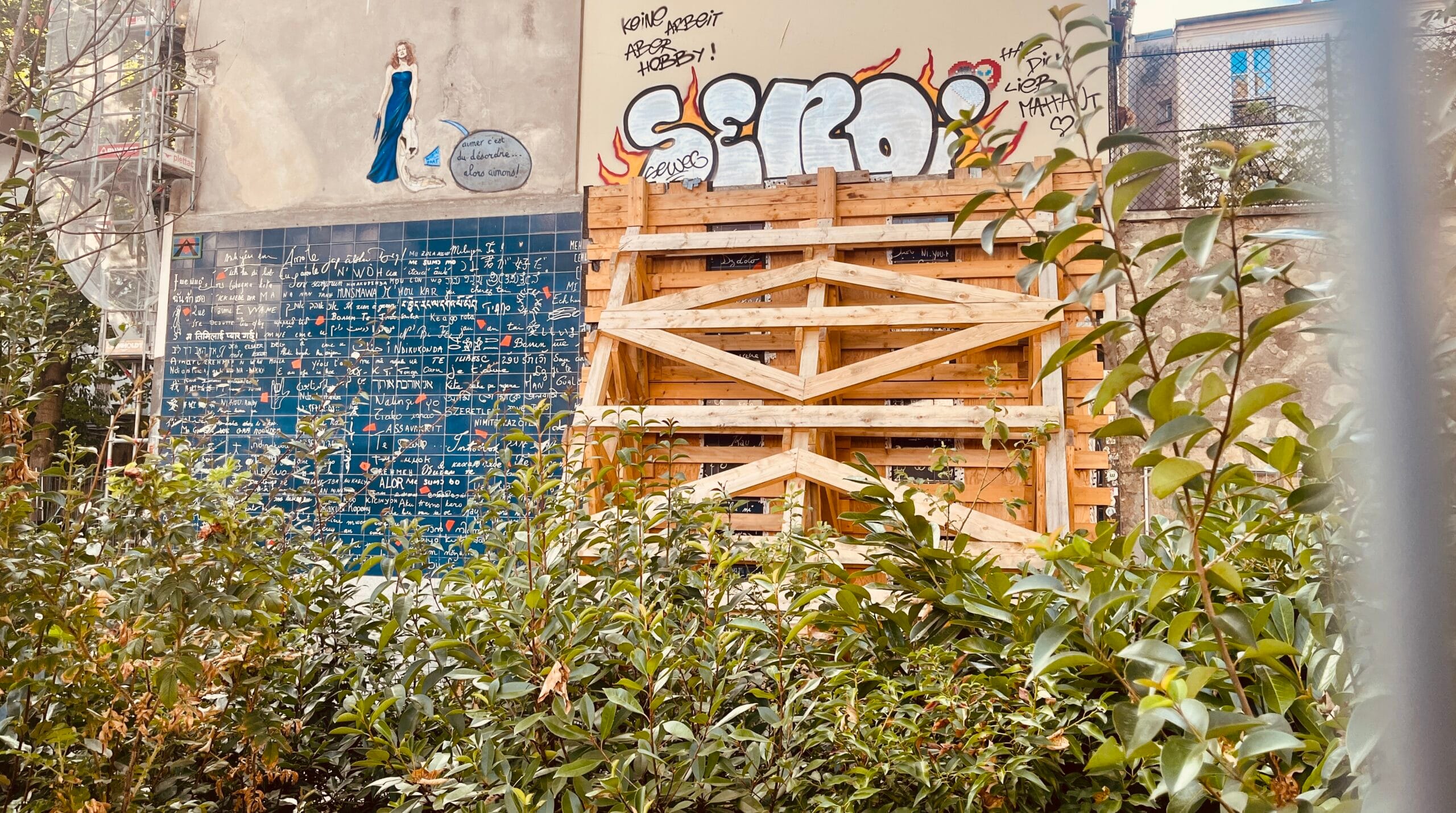
Le Mur des Je t’aime as it looks in summer 2026 — currently under restoration, partially obscured by scaffolding. Still worth the detour. © montmartre-in-paris.com
4. Studio 28 — Paris’s First Avant-Garde Cinema
Opened in 1928 on a quiet street above Place des Abbesses, Studio 28 was the first cinema on the Right Bank dedicated to avant-garde film. Luis Bunuel screened Un Chien Andalou here. Salvador Dali attended. Jean Cocteau designed the lights. The building still functions as a cinema today — small, intimate, Art Deco, with original details intact and a programme that mixes restored classics, French independents and international films.
The hidden element is the cafe-bar at the back, accessible without a cinema ticket. It is one of the most atmospheric rooms in Montmartre — film posters covering the walls, warm lighting, the occasional velvet curtain. The kind of place that feels like a discovery even if you find it by accident. Worth going to before a screening, or simply for a drink on a wet Paris afternoon when the main sights are crowded and uninviting.
5. Place du Calvaire — Views Without the Crowds
Place du Tertre is forty metres away and at full tourist capacity from 10am. Place du Calvaire, accessible through a small passage at the eastern edge of the Tertre, is almost always empty. It is a tiny square — barely twenty metres across — perched on the edge of the Butte with a panoramic view south over Paris that rivals anything at Sacre-Coeur. No vendors, no easels, no queues. Locals come here at sunset for drinks from the nearby cafe. Most tourists never find the passage that leads to it.
6. Allee des Brouillards — The Lane That Time Forgot
A narrow private-feeling lane on the western slope of the Butte, flanked by 18th-century cottages with front gardens — an anomaly in Paris, where front gardens essentially do not exist. The Chateau des Brouillards at the end of the lane was once a pleasure house, then a laundry, then the home of poet Gerard de Nerval. Renoir lived nearby. The whole lane is residential, quiet and disorienting — it does not feel like a city at all. Follow it and it connects to the Allee Rachmaninov, which is equally obscure.
7. Cimetiere Saint-Vincent — Utrillo, Honegger, and Quiet
The smallest cemetery in Paris and one of the least visited. It sits on the northern slope of the Butte, a two-minute walk from the vineyard corner, and contains the graves of Maurice Utrillo (the painter who documented Montmartre obsessively throughout his life), Arthur Honegger (the composer), and Eugene Boudin. The cemetery is tiny — a single path, a handful of graves, trees overhead. It takes ten minutes to visit and is one of the most peaceful spots on the hill. The entrance is easily missed.
8. Rue Saint-Rustique — The Oldest Street on the Butte
The oldest street in Montmartre, running between Place du Tertre and Rue des Saules, and one of the few that still looks like the 18th-century village the neighbourhood once was. No souvenir shops, no easels. The cobblestones are original, the walls are old stone, and the street is narrow enough that two people can barely pass side by side. Le Consulat restaurant occupies the corner and is worth noting — one of the oldest bistros on the Butte, with a terrace that fills on warm evenings.
9. Hotel Particulier Garden — The Secret Cocktail Bar
Avenue Junot is already one of the quieter streets in Montmartre. Hidden behind the gate of the Hotel Particulier — a 19th-century private mansion converted into a boutique hotel — is a walled garden that operates as a cocktail bar and tea room, open to non-guests. It is the kind of place that feels genuinely secret: lush planting, fairy lights in the trees, no street noise, no tourists. Expensive drinks, but one of the most atmospheric outdoor spaces in Paris. Go in the late afternoon.
10. Terrass Hotel Rooftop — The Panorama Parisians Keep to Themselves
The Terrass Hotel sits at the edge of the Butte and its rooftop offers a 360-degree panorama of Paris — Sacre-Coeur behind you, the Eiffel Tower directly ahead, the city spread below. The rooftop restaurant and bar are open to non-guests. It is not cheap, but it is significantly less expensive than the restaurant at the Eiffel Tower for a comparable view, and the sunset from here is one of the better ones in Paris. Walk in without a reservation outside of peak season. In July and August, book ahead.
Private Montmartre Tours
A private guide can take you to spots like these at your own pace.
Browse private tours on GetYourGuideAffiliate link. Prices and availability are shown on GetYourGuide.
How to See These Spots — Practical Notes
All ten spots are within a 20-minute walk of each other. A logical circuit from Abbesses station: Wall of Love (Square Jehan Rictus, 2 min from metro) → Studio 28 (Rue Tholoze, 3 min) → Hotel Particulier garden (Avenue Junot, 5 min) → Allee des Brouillards (off Rue Simon Dereure) → Place Dalida (Rue de l’Abreuvoir, 10 min) → Le Passe-Muraille (Place Marcel Ayme, 5 min) → Place du Calvaire (off Place du Tertre, 3 min) → Rue Saint-Rustique (2 min) → Cimetiere Saint-Vincent (Rue des Saules, 8 min) → Terrass Hotel rooftop (Rue Joseph de Maistre, 12 min). Allow 3–4 hours at a comfortable pace. Prefer a guide? Compare the best Montmartre tours that go beyond the standard circuit.
None of these spots require tickets or reservations, with the exception of Studio 28 for screenings and the Hotel Particulier garden in peak season. The best time for all of them is mid-morning on a weekday — the tourist circuit is occupied elsewhere and the residential streets are at their quietest.
Guided Hidden Montmartre Tours
Small-group tours with local guides that go beyond the standard circuit — covering the stories behind the hidden spots and the streets most visitors never find.
Browse Montmartre Tours →
💡 Frequently Asked Questions
Place Dalida for the best unobstructed Sacre-Coeur view, Le Passe-Muraille sculpture on Place Marcel Ayme, Studio 28 cinema with its secret bar, Place du Calvaire for panoramic views without crowds, and Allee des Brouillards for a lane that feels nothing like Paris.
In Square Jehan Rictus on the north side of Place des Abbesses — two minutes from the Abbesses metro exit. Free to visit, open all day. The blue ceramic tiles show ‘I love you’ in 312 languages.
A quiet square off Rue de l’Abreuvoir named for the singer Dalida, who lived in Montmartre until 1987. It has a bronze bust of Dalida and one of the best framed views of Sacre-Coeur on the northern slope.
Paris’s first avant-garde cinema, opened in 1928 on Rue Tholoze. Still operating as an independent cinema with a bar accessible without a ticket — one of the most atmospheric rooms in the neighbourhood.
Yes. The Hotel Particulier on Avenue Junot has a walled cocktail garden open to non-guests. The Musee de Montmartre gardens overlook the vineyard. Allee des Brouillards has 18th-century cottages with front gardens found nowhere else in Paris.